
Making IPOs Great Again

Key Takeaways
Public markets fuel innovation and opportunity.
Public markets connect investors with businesses, governments and nonprofits that need capital to innovate, expand and create jobs.
The decline in public companies matters.
With fewer public companies, opportunities for investment and wealth creation become concentrated among a smaller group of private investors.
The SEC wants to make going public easier.
Proposed changes would reduce regulatory burdens, focus disclosures on material information and encourage more companies to access public markets.
One of the most important functions of our modern financial system is to connect asset owners – stewards of capital – with the businesses, governments and not-for-profit organizations that can deploy that capital to help real people in the real world achieve their goals. And one of the most refreshing and exciting developments coming out of Washington these days is the capital formation agenda of the U.S. Securities and Exchange Commission and its chair, Paul Atkins. The SEC is seeking to reverse a decades-long trend of financial rulemaking that has impeded the ability of issuers of debt and equity to tap public markets for productivity-enhancing, wealth-creating capital.
Atkins has repeatedly stated that the SEC should facilitate capital formation, not create friction points that discourage users of capital from accessing public markets, and has emphasized the following three themes.
Theme 1: Too Few Companies Are Going Public
After peaking in 1996 at 8,090, the number of publicly listed companies in the U.S. had fallen precipitously – in spite of decades of economic growth, global market expansion and new industries and technologies.
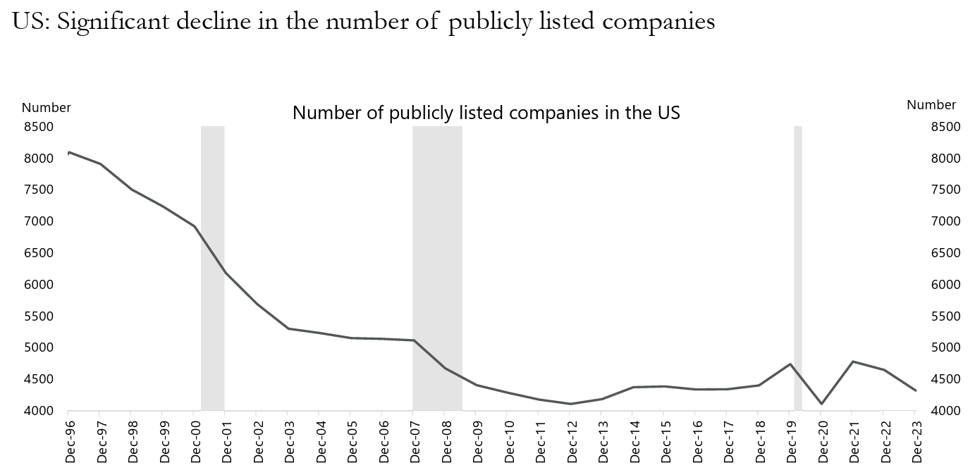 Chart. The number of listed domestic companies in the United States has declined significantly since the mid-1990s. Source: World Development Indicators (World Bank), Apollo Academy.
Why is this drop such a concern? Because capital formation funds innovation (like medical and pharmaceutical breakthroughs), business expansion, infrastructure and job creation. If public markets become less accessible, those benefits are dependent on capital from a smaller and more concentrated group of private investors.
To that point, Atkins has often argued that public markets should once again be a primary engine of capital formation and wealth creation. In his April 2026 “Boom Belt” speech, he called the precipitous decline in IPOs a “cautionary tale” that must be reversed if we are to “make our public markets the natural destination for companies to raise capital and for investors to share in their success.”
Theme 2: Regulation Should Be Guided by Materiality
Atkins believes disclosure requirements have expanded beyond information that is economically important to investors, accomplishing little but increasing compliance costs. At a February 2026 dinner for the Association for Financial Markets in Europe, he expressed a desire “to simplify and scale disclosure requirements to reduce the costs of preparing SEC filings and, at the same time, make them more comprehensible so that investment decisions can turn on economic signals rather than regulatory noise.” (At the same event, he likened these “limiting regulatory burdens” to “barnacles clinging to [a ship’s] hull.”)
Theme 3: The SEC Should Facilitate, Not Impede, Capital Formation
Atkins’ “Make IPOs Great Again” agenda also encompasses:
- Depoliticizing shareholder meetings. Atkins has argued that shareholder meetings, shareholder proposals and other elements of corporate governance should primarily concern the election of directors, significant corporate matters and matters directly affecting corporate value. He has also expressed concern about the growth of nonbinding shareholder proposals, particularly those related to environmental, social and political issues, and suggests a narrower interpretation of what belongs on corporate ballots.
- Litigation reform. Atkins is seeking to reduce what he characterizes as frivolous securities litigation, reflecting a belief that litigation risk has become a meaningful deterrent to public-company formation and growth. Areas he has discussed publicly include reconsidering restrictions on arbitration provisions and limiting litigation that may discourage innovation or public listings.
- Expanded pre-IPO “test-the-waters” communications and easier engagement with potential investors before an IPO.
- Modernized accredited-investor standards that recognize financial sophistication, not just wealth and income.
Atkins’ capital formation agenda is a market-oriented effort to reverse the long-term decline in U.S. public companies. It is built on the premise that a greater focus on material disclosure, lower compliance costs, streamlined governance requirements and reduced litigation burdens would make public markets more attractive to issuers. It’s a welcome reversal of decades of regulatory heavy-handedness.