
Bubble Bubble, Toil and Trouble: New Indications of Market Excess
Like fellow veteran market participants, I have experienced three full-fledged bubbles during my 40+ year financial services career – the Japanese property bubble of the 1980s, the dot-com bubble of the late 1990s and the mortgage-fueled financial crisis of 2008–2009. I’m no market prognosticator, but from where I sit, the signs of excess that accompany bubbles are unmistakable – and I’m concerned that a new one might be forming now.
Start with conspicuous consumption. As my colleague and Strategas chair Jason Trennert recently wrote, “Discretion among the ultra-wealthy seems hopelessly Victorian now. Displaying one’s wealth appeared to reach some sort of fevered pitch in the summer of 2025. It is difficult to read the weekend section of any major newspaper that does not feature things like an $8,000 cocktail, millions-dollar-plus rentals in the Hamptons, and the joys of flying private.” The Wall Street Journal recently reported that the top 10% of earners (those making $250,000 or more annually) in the United States account for nearly half of the country’s spending.
Then there’s the U.S. stock market, which by every metric Strategas tracks is at the upper end of its historical range. Enterprise value, multiple of sales valuations, the Shiller Cyclically Adjusted Price-to-Earnings ratio – all of these are flashing red.
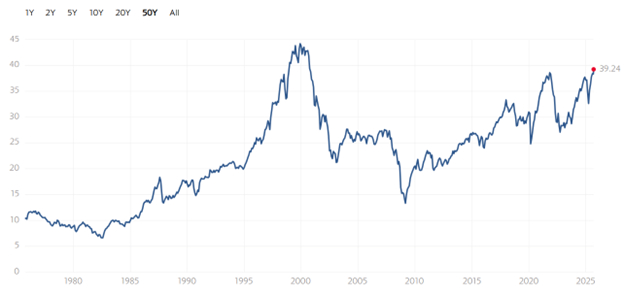
The Shiller CAPE ratio, which assesses if a market is over- or undervalued, is at its highest point since the burst of the dot-com bubble in March 2000. Source: Multipl.com.
Which brings us to crypto – the collateralized default swap equivalent of the 2020s. It’s not so much the digital tokens themselves, but the inane make-a-quick-buck schemes foisted on the investing public. Michael Saylor’s firm MicroStrategy has accumulated $70 billion in bitcoin and spawned a wave of crypto and digital asset treasury companies accumulating various types of meme coins, throwing fresh fuel onto what the Wall Street Journal dubbed “the Infinite Money Glitch.” Over the same time, Robinhood Market’s stock has shot up over 400% in the last year partly due to offering “tokenized” versions of U.S. equities to foreign investors – never mind that these tokens represent uncollateralized obligations of Robinhood itself, rather than ownership interests in the underlying companies.
And don’t look for help from industry regulators – Congress has passed and is considering several pieces of legislation enabling crypto activities, and regulators, particularly the SEC, are signaling a far more permissive approach. As Lee Reiners, a fellow at the Duke Financial Economics Center, recently told Barron’s, “All the guardrails are being taken off at once. … There will be another downturn, and when it happens, the pain will be acute.” Another market observer told Bloomberg, “I think the collapse of a major DAT [digital asset treasury company] is going to set the dominoes in motion for this bull cycle to end.”
What Investors Can Do
Fortunately, the degree to which the digital asset craze has insinuated itself into the mainstream financial system is still relatively limited – though even that is changing. Regulated financial institutions like Bank of America and Citigroup are looking at creating their own stablecoins, digital tokens collateralized by U.S. Treasurys and legitimized by the recently passed GENIUS Act. Others are looking at lending against digital asset or allowing crypto assets to be counted when applying for home mortgages. The Financial Times reported recently about “microfinance on steroids” – “a new generation of high-octane crypto venture expanding risk-taking with new forms of digital loans” supported and enhanced by artificial intelligence. “We’re loaning to average folks like high-school teachers, fruit vendors … basically anyone with access to the internet can get access to our funds,” the founder of a lender called Divine Research reported.
Which raises the question: How should investors be thinking about these developments? My recommendations:
- First, acknowledge these indicators for what they are – signals of market froth. These indications are worrying ... though a market downturn is far from a sure thing.
- Review your asset allocation, particularly how your portfolio would perform in a pullback. Would you be comfortable with the kind of drawdowns associated with bursting bubbles?
- Look for opportunities to diversify, including low correlated asset classes like managed futures.
- Check to make sure you have adequate liquid reserves, including lines of credit. Two years’ worth of living expenses isn’t overdoing it. (As an illustration, Berkshire Hathaway has almost $350 billion in short-term reserves.)
Go Back to the Start
At the risk of sounding “hopelessly Victorian,” I would repeat what I wrote a decade ago amid the detritus of the Great Recession: That every time our financial system gets away from its core purpose – which is to connect sources of capital with productive enterprises in a way that improves everyone’s quality of life – we end up creating varying degrees of mayhem for society. I’m concerned we may be on the precipice of having to learn that lesson once again.
The information reflected on this page are Baird expert opinions today and are subject to change. The information provided here has not taken into consideration the investment goals or needs of any specific investor and investors should not make any investment decisions based solely on this information. Past performance is not a guarantee of future results. All investments have some level of risk, and investors have different time horizons, goals and risk tolerances, so speak to your Baird Financial Advisor before taking action. The views and opinions expressed here are those of the speaker and do not necessarily reflect the views or positions of the firm.