AI-Enabled Industrial Software Takes Center Stage
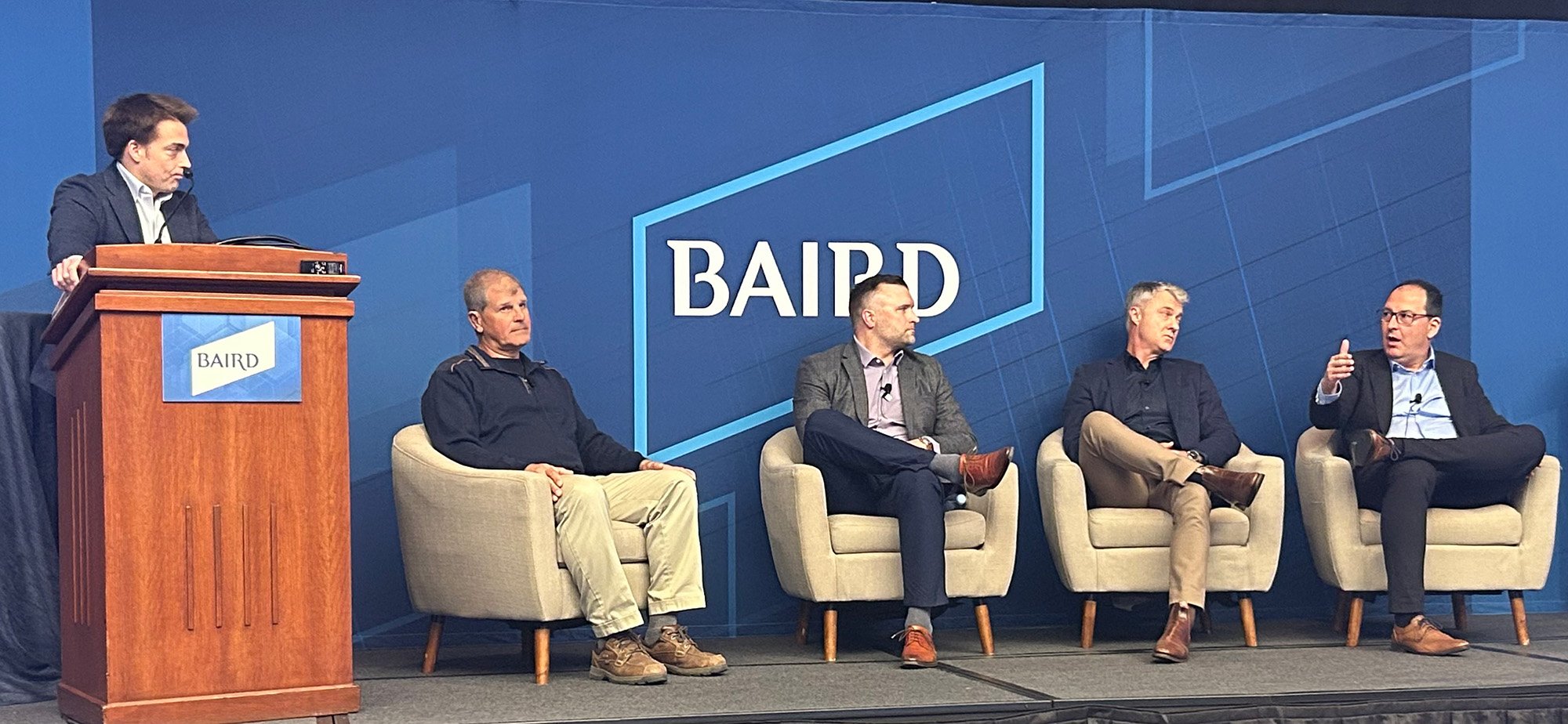
At Baird’s 55th Annual Global Industrial Conference, our Industrial & AEC Software Team curated a showcase of leading industrial software companies with the exclusive panel, “AI & Industrial Operations.” This event brought together 2.4k+ attendees from around the world, including management teams from nearly 300 public industrial companies and 1k+ institutional investors, underscoring Baird’s role as a hub for thought leadership and strategic connection across the industrial ecosystem.
The panel moderated by Joe Vruwink, Baird's Senior Equity Research Analyst covering Vertical Software, featured a powerhouse cross-section of executive leaders from across the Industrial Software landscape, including:
- James Balzary, Co-Founder, TilliT / Managing Director, Roima
- Joe Bellini, CEO, Eyelit
- Stefan Jesse, CEO, AMDT
- Josh Roberts, VP Americas, Epicor
Below, we spotlight the key themes from this session, distilled from candid, real-world perspectives at the intersection of industrial operations and next-generation technology.
Five Key Themes from the "AI & Industrial Operations" Panel
- The Foundational Imperative: Data, Security, and the Unified Model
The panel’s most urgent message was that AI success is impossible without a modern data foundation. This requires moving beyond siloed legacy systems to create a clean, accessible, and unified data model. This is especially critical in Operations Technology (OT), where the stakes are higher and a single data error can lead to catastrophic safety or financial outcomes, demanding a unique focus on security and reliability.
Key Panelist Observation: You simply "cannot run a 2025 AI model on a 2005 data infrastructure." - Strategic AI: Shifting to Autonomy and Building a Competitive Moat
The conversation confirmed that the strategic endgame for AI is not just better analytics but a decisive shift toward autonomous operations—where systems act, not just advise. When trained on a company's proprietary operational data, AI becomes a powerful competitive moat, creating operational intelligence that is unique and cannot be easily replicated by competitors or commoditized by new market entrants.
Key Panelist Observation: Companies investing now are creating "proprietary operational intelligence that their competitors just cannot replicate."
- Specialized AI is Driving New, Value-Based Economic Models
The panel stressed that "AI" is not a monolith but a collection of specialized tools (ML, LLMs, agents) for specific jobs. This specialization is enabling a fundamental shift in business models, moving away from traditional software licensing toward consumption-based or outcomes-based pricing that directly ties cost to the value AI generates, such as documented efficiency gains or quality improvements.
Key Panelist Observation: Vendors charge for "operational efficiency gained" or "quality outputs that the AI tool generates."
- Adopt an "Embrace and Extend" Strategy
The most pragmatic path forward is not to "rip and replace" but to identify partners who can work with and enhance existing infrastructure. The goal is to find solutions that can intelligently "embrace" the current systems and "extend" their capabilities to solve specific, high-value problems, such as closing the gap between static plans and dynamic execution on the factory floor.
Key Panelist Observation: "We just take the approach, embrace and extend."
- AI as a Productivity & Talent Multiplier
Beyond the factory floor, AI is already proving to be a massive force multiplier for internal operations. Panelists reported significant (30-40%) efficiency gains in their own software development teams and a dramatic reduction in the ramp time for new hires. This allows companies to scale and handle growth without a linear increase in headcount, driving significant operating leverage.
Key Panelist Observation: For new employees "we've been able to cut the ramp time to productivity down by about 30 to 40%."
The Bottom Line
The industrial sector has reached a pivotal moment: as decades-old, under-digitized operations modernize their data and embrace AI, competitive advantage is shifting to those who invest in foundational infrastructure and unified data models. Those that adapt quickly will shape the next era of industrial leadership and long-term value creation.
To discuss these topics further, contact a member of our Industrial AEC Software team.
North America Team
Rodd Langenhagen
+1-617-247-8376
rlangenhagen@rwbaird.comTom Schadewald
+1-414-298-7479
tschadewald@rwbaird.com
European Team
Marco Krass
+49-69-1301-4970
mkrass@rwbaird.comDan Bruton
+44-20-7667-8443
dbruton@rwbaird.comChelsea Smith
+44-20-7667-8342
cmsmith@rwbaird.com